
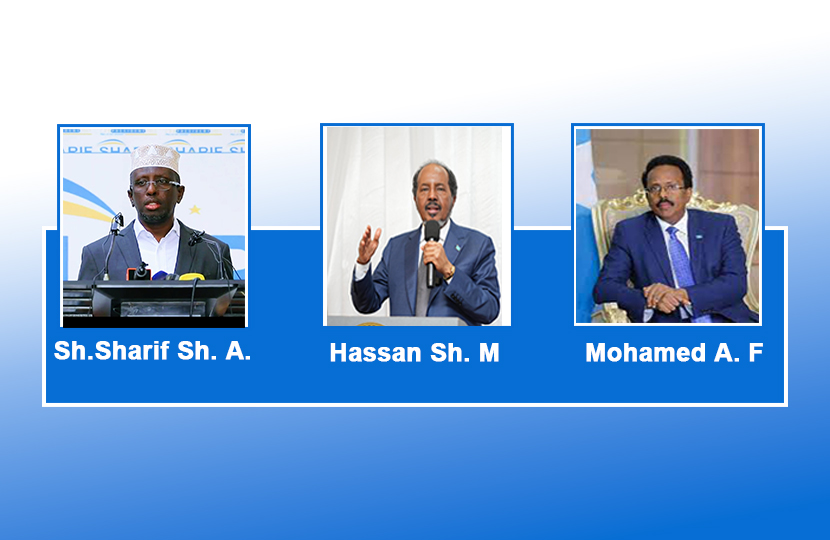
The three presidents, “Sharif Sheikh Ahmed, Hassan Sheikh Mohamud, and Farmaajo”, each guided Somalia through phases of recovery, rebuilding state institutions, fostering stability, and advancing economic reforms, leaving distinct legacies in the nation’s path toward lasting governance.
Sheikh Sharif Sheikh Ahmed (2009–2012)
When Sheikh Sharif Sheikh Ahmed became president in 2009, Somalia was at one of its lowest points. The capital was divided by frontlines, institutions had completely collapsed, and the idea of a functioning government felt almost impossible. Many of us who lived through that time remember the exhaustion — decades of conflict, warlords, and chaos. So when Sheikh Sharif, a former leader of the Islamic Courts Union, was elected to lead the Transitional Federal Government, people saw a chance for something different: a leader who could combine faith, moderation, and national reconciliation.
What He Did Well
The first and most visible achievement under Sheikh Sharif was improving security in Mogadishu. When he came to power, much of the city was controlled by Al-Shabaab. Through cooperation with the African Union Mission in Somalia (AMISOM) and Somali government forces, his administration gradually regained key districts. By mid-2011, the president announced that Al-Shabaab had retreated from the capital. For those of us living in Mogadishu then, that was not just a military success — it was emotional. It meant we could finally walk through parts of the city that had been war zones for years.
Sheikh Sharif also worked to rebuild the foundations of the state. His government restarted essential institutions such as the Central Bank, the national army, and the police force. Ministries that had existed only on paper began to function again, even if imperfectly. For the first time in a long while, the word “government” started to mean something tangible.
Another major step was the drafting of Somalia’s Provisional Constitution. Under his leadership, the country moved closer to establishing a constitutional framework that recognized human rights, the rule of law, and a federal system. Even though it was a transitional process, it gave Somalia a sense of direction after so many years of uncertainty.
I also remember Sheikh Sharif as a leader who valued dialogue and inclusion. He reached out to clans, civil society groups, and religious leaders. His ability to speak calmly, to listen, and to avoid unnecessary confrontation gave his government a softer image compared to the militarized regimes of the past. Perhaps his greatest political act was handing over power peacefully in 2012 — something Somalia had not seen in decades. That gesture alone set a powerful precedent for democratic transfer of leadership.
Hassan Sheikh Mohamud (2012–2017)
When Hassan Sheikh Mohamud was elected president in 2012, many of us — myself included — felt a cautious sense of hope. After years of chaos and transitional governments, Somalia seemed to have found a civilian leader with a calm demeanor and a background in education and civil society rather than war or factional politics. His election symbolized a new beginning, and for the first time in decades, many Somalis believed that a government might actually start to function again.
What He Did Well
To be fair, Hassan Sheikh brought Somalia back to the world stage. Under his leadership, the country regained international recognition and began rebuilding diplomatic relationships that had been broken for more than two decades. Foreign embassies reopened in Mogadishu, and high-level visits from world leaders signaled a new kind of legitimacy for the Somali state. It was during his term that Somalia started to regain a seat at regional and international tables — a psychological and political breakthrough after so many years of isolation.
Another achievement was his role in advancing the federal system. Hassan Sheikh pushed forward the formation of new federal member states, including Jubbaland and South West State, which helped shape Somalia’s current political structure. Although this process was messy and controversial, it created a sense of inclusion for different regions and clans, and gave political meaning to the federal vision written in the Provisional Constitution.
He also placed emphasis on youth, education, and rebuilding institutions. As someone from an academic background, he spoke often about the importance of education and opportunity. During his tenure, there were visible efforts to reopen schools, support universities, and invest in public infrastructure such as roads and hospitals. He projected an image of a leader who valued dialogue and intellect — not confrontation or force — and that tone, for a country long used to conflict, mattered deeply.
Mohamed Abdullahi “Farmaajo” (2017–2022)
When Mohamed Abdullahi “Farmaajo” took office in early 2017, the mood across Somalia was electric. For the first time in many years, there was genuine excitement in the air — people danced in the streets, cars honked in celebration, and social media overflowed with hope. Farmaajo was seen as a nationalist, a reformer, and a man who spoke the language of ordinary Somalis. Many believed he would finally deliver the strong leadership, discipline, and dignity that the country had longed for.
What He Did Well
Farmaajo’s rise to power came with a message of sovereignty and national pride. He presented himself as a leader who would put Somalia’s interests first — after years of dependence on donors and political compromise. His speeches emphasized unity, self-reliance, and the dignity of the Somali state. For a people tired of weak governments and endless negotiations, this resonated deeply.
One area where he showed notable commitment was reforming and strengthening the national army. His administration began to rebuild the Somali National Army (SNA), improve training, and push for better coordination with regional forces. There was renewed emphasis on paying soldiers regularly and building a sense of national command. While the results were uneven, many saw it as the first serious effort to restore the pride of the Somali military since the civil war.
Farmaajo’s government also reclaimed greater control over foreign policy. He tried to centralize external relations and reduce the influence of foreign actors in domestic politics. His firm stance during regional disputes — such as neutrality in the Gulf Crisis (2017) — reflected an attempt to assert Somalia’s independence, even when it came with political cost. To many Somalis, this was refreshing: a leader who dared to say “no” when necessary.
Economically, his administration achieved some important milestones. Under his government, Somalia qualified for debt relief under the Heavily Indebted Poor Countries (HIPC) Initiative — a major financial breakthrough that opened the door to long-term development. Public financial management also improved in some areas, with greater oversight of the Central Bank and government payroll.
This comparative analysis of Sharif Sheikh Ahmed, Hassan Sheikh Mohamud, and Mohamed Abdullahi Farmaajo reflects my own critical interpretation of their leadership styles and political legacies in light of Somalia’s evolving governance framework. The ideas presented here are entirely my perspective, grounded in my understanding of both the Somali Constitution (2012) and relevant political theory. I welcome any constructive comments or academic feedback to correct possible inaccuracies or strengthen the overall argument.
Yusuf Osman Mohamud


